What Is Ground School? (And Do You Need It?)
by Paul Duty
Published
Updated
If you’ve started considering becoming a pilot, you’ve probably heard the term “ground school”. And if you’re like most people, it’s not immediately clear what that actually means. Is it a class? A requirement? Something separate from flying? Can you skip it?
The short answer is this: ground school is where you learn the conceptual knowledge about aviation. It’s not done in an airplane. It’s done on the ground and covers subjects that every pilot must know and understand. You can approach it solo, if you wish, and learn it straight out of the books. But most people learn from online courses or in-person classes.
What Is Ground School?
Ground school is the knowledge-based portion of your flight training. It teaches you how aviation works so you can safely and confidently operate an aircraft in the national airspace system.
Ground school covers a lot, and to become a safe pilot, you’ll need to develop a solid understanding of each area. Some of the core topics include:
- How airplanes fly
- Aircraft systems and performance
- Weather and how it affects flying
- Airspace and radio communication
- Navigation and flight planning
- FAA rules and regulations
And there’s actually a lot more, we’ll get into that shortly. But for now, take a second and think about how much you really know about each of these.
We could go pretty deep into any one of them. The challenge is you don’t know what you don’t know. You might have some prior knowledge, and that’s a great start, but to truly understand how everything connects, and to make sure what you know is accurate, you need a structured approach. That’s what ground school provides.
As you get more familiar with the training process, you’ll probably hear about shortcuts to pass the tests quickly. And we get it, there’s a lot to learn, and you’re not going to master everything right away. Some people think, “I’ll just learn it when I’m actually flying,” or they start looking for the fastest way to get through it.
Yes, you need this knowledge to pass the FAA written test. But the test is not the goal. Becoming a safe, confident pilot is the goal. That’s also why simply memorizing answers is a bad strategy. It won’t prepare you for real-world flying. We have another article you should check out to see why memorization is a bad idea for pilot training.
You will pick up some things during flight training, but ground school is what makes you ready to learn in the first place. Experience is a good teacher, but evaluated experience is where real learning happens.
Think of ground school as an investment.
You’ll hear people talk about how long it takes to solo an airplane, or how long it takes to earn a pilot certificate. Those conversations are a lot more meaningful when you include ways to actually reduce that time.
One of the biggest ways to do that is ground school.
When you come prepared, you learn faster. Your instructor can build on your knowledge instead of backfilling gaps. Without that foundation, frustration builds quickly, for both you and your instructor. It can even start to strain the student-instructor relationship, not because anyone wants that, but because you’re simply not ready to move forward yet.
No instructor wants to slow you down. We want you to succeed, and we want you to do it efficiently. But we also have to make sure you’re safe.
And understand this: ground school will save you thousands of dollars in flight training expenses along the way.
What Do You Learn in Ground School?
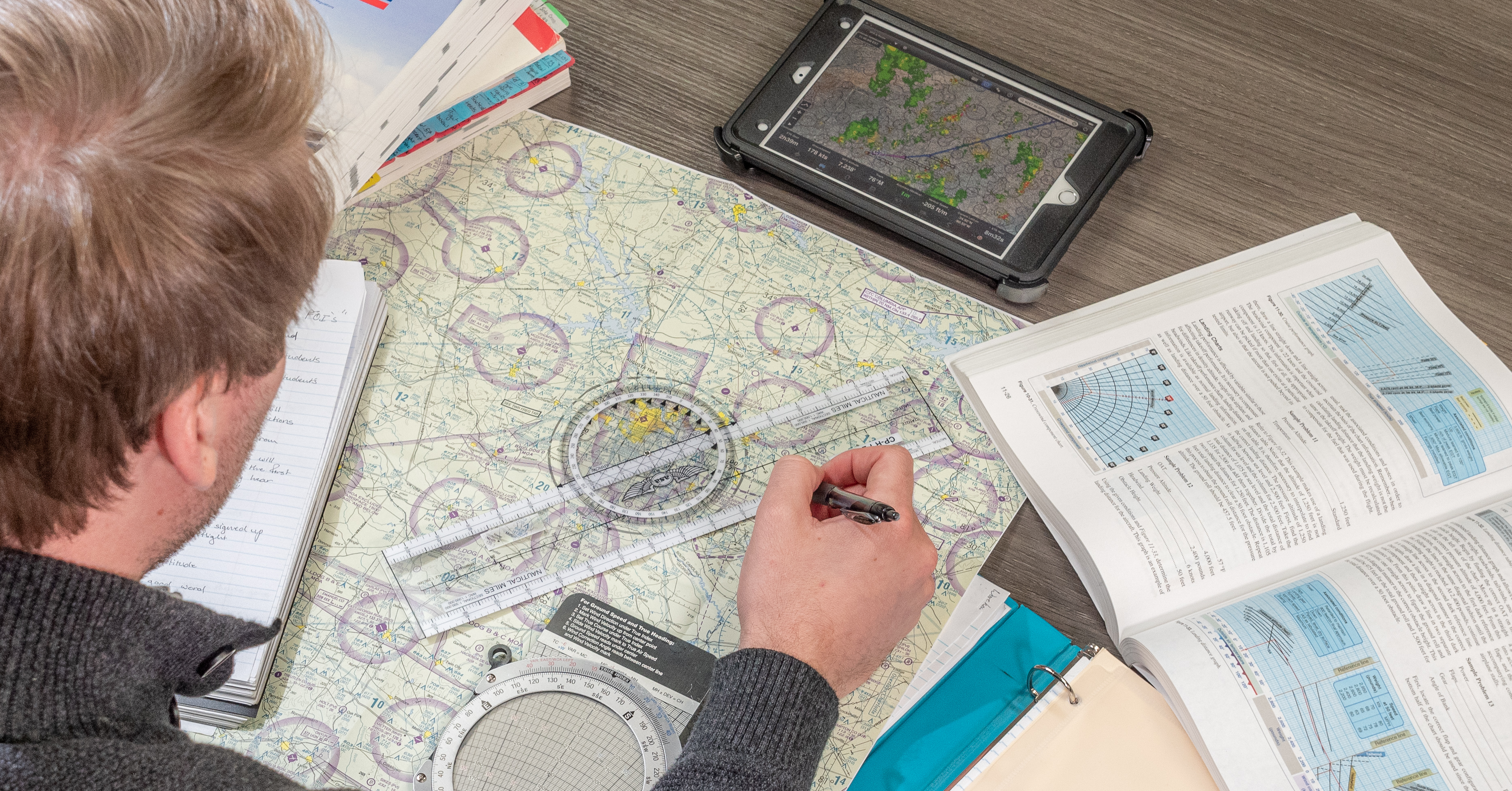
Ground school can feel overwhelming at first, but it really comes down to a few core areas that you’ll build on throughout your training. So, let’s come back to those topics that I mentioned earlier. At first glance, they seem pretty straightforward. But once you start digging in, you realize there’s a lot more going on beneath the surface. That’s exactly what ground school is designed to walk you through.
You’ll start with how airplanes actually fly, learning the fundamentals of lift, drag, thrust, and how your control inputs affect the aircraft. From there, you’ll move into aircraft systems and performance, understanding how the engine, electrical system, fuel system, and flight instruments all work together, and how those systems impact what the airplane can and can’t do.
Weather is another major focus. You’ll learn how it affects flying, how to read reports like METARs and TAFs, understand forecasts, and recognize hazardous conditions before they become a problem.
You’ll also develop a clear understanding of airspace and communication, where you can fly, how different environments operate, and how to communicate effectively within them.
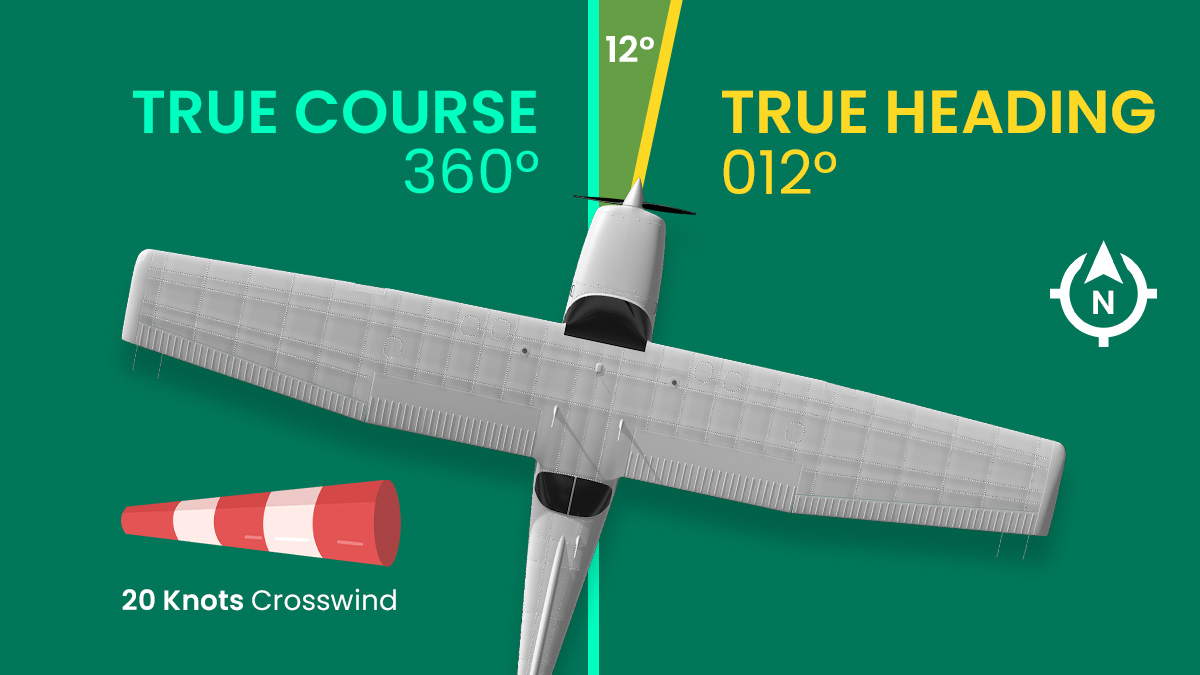
From there, you’ll learn navigation and flight planning, how to get from point A to point B using sectional charts, GPS, and traditional methods like dead reckoning and pilotage.
And throughout all of this, you’ll be learning FAA rules and regulations, including your privileges and limitations as a pilot, airspace requirements, weather minimums, and required equipment.
As you continue through your training, each certificate or rating builds on what you’ve already learned. You’re not starting over, you’re expanding your understanding as you’re introduced to more complex aircraft, more advanced procedures, and more demanding flying environments.
And this isn’t just academic knowledge. This is what allows you to make safe, confident decisions in real-world flying.
How Ground School Fits Into Flight Training
Now that you’ve seen what you actually learn in ground school, the next step is understanding how it connects to what you’ll do in the airplane. This is where everything starts to come together. You need a solid understanding of the fundamentals before you can apply them, and more importantly, before you can start correlating what’s happening in real-world flying.
Ground school and flight training are meant to work together.
Think of it like this: ground school teaches you why, and flight training teaches you how. When you understand the “why” first, the “how” makes a lot more sense.
For example, understanding weather helps you make better go or no-go decisions before you ever step into the airplane. Understanding airspace helps you communicate properly and confidently with air traffic control. Understanding aerodynamics improves how you actually control the airplane, because you know what’s happening physically, instead of just reacting.
This is where a lot of students either accelerate or fall behind.
Students who build that knowledge early come into each lesson prepared. They’re able to connect what they’re learning on the ground to what they’re doing in the air. They tend to progress faster, make fewer mistakes, and ultimately spend less money in training.
When that foundation isn’t there, everything feels harder than it needs to be. You’re trying to perform tasks without fully understanding them, and that slows down your progress. But, when it is there, everything starts to click.
That’s the role ground school plays, preparing you to get the most out of every minute you spend flying.
Do You Need Ground School?
Yes, if you actually want to become a pilot.
To earn your private pilot certificate, you must pass the FAA knowledge test, often called “the written.” Ground school is how you prepare for it. Now technically, the FAA does not require you to attend a formal class. You can study on your own.
But in practice, most students who try to piece everything together on their own run into the same problems, gaps in knowledge, confusion from conflicting information, and slower progress once they start flight training.
That’s why the most successful pilots choose a structured approach.
And the good news is, you’ve got a few different ways to do that. Let’s walk through those options next so you can decide what fits you best.
Your Options for Ground School
There are three main ways to complete ground school, and the right choice really depends on your learning style, schedule, and how much structure you want.
The first option is to self-study. This option uses books and free resources, such as FAA handbooks, YouTube videos, and various study guides you can find online. The biggest advantage here is cost, it’s often the least expensive option, and it gives you complete flexibility to learn on your own time. But there’s a tradeoff. Without structure, it’s easy to miss key concepts, go down the wrong path, or spend time on things that don’t really matter. A lot of students end up piecing together information without ever feeling fully confident in what they know.
This second option is to take a classroom ground school, typically offered by your local flight school or a formal collegiate program. This gives you a structured environment and the ability to interact directly with an instructor, ask questions, and learn alongside other students. For some people, that classroom setting works really well. On the downside, you’re tied to a fixed schedule, and the quality can vary quite a bit depending on the instructor and the program. It’s also often slower paced, since it has to match the pace of the group.
The third option has become the most common approach today. It’s a complete online program. This gives you the structure that most students need, but with the flexibility to learn at your own pace. A well-designed online course walks you step-by-step through the material, keeps you organized, and prepares you specifically for the FAA written test. You can access it from anywhere, and revisit lessons as needed. The main challenge here is that it does require some self-discipline, since you’re responsible for staying on track. But if you follow the process, you really get the best of both worlds, the flexibility of self-study and the structure of an in-person class. Your own pace, with a clear path forward.
That said, not all online ground schools are created equal. If you need help along the way, make sure it’s available, and that it’s coming from a real human.
Each of these options can work. The key is choosing an approach that gives you both clarity and consistency, so you’re not just learning, but actually building understanding as you move forward.
What Most Students Get Wrong About Ground School
 Hopefully by now, you can see how ground school fits into flight training. So why do so many students still get off track? In most cases, it comes down to a few common mistakes or misconceptions about how ground school actually works. If you can avoid these early, it will make a big difference in how smoothly your training goes.
Mistake 1: Treating It Like Just a Test
Some students focus only on memorizing answers so they can pass the FAA written test as quickly as possible.
Reality: This knowledge directly impacts your safety and decision-making in the air. If you don’t truly understand it, you’re going to feel that gap when you’re flying. The goal isn’t just to pass a test, it’s to build the foundation you’ll rely on every time you step into the airplane.
Mistake 2: Delaying Ground School
Many students wait until later in training to really start learning the material, thinking they’ll pick it up as they go.
Reality: Starting earlier actually speeds everything up. When you understand what’s happening, your flight lessons become more productive, less frustrating, and more efficient. You’re not just reacting, you’re learning with purpose.
Mistake 3: Jumping Between Random Resources
This means trying to piece everything together from different books, videos, and sources without a clear plan.
Reality: This often creates confusion instead of clarity. You may pick up bits and pieces, but without structure, it’s hard to connect everything or know what really matters. That lack of clarity slows down your progress more than anything else.
The students who succeed fastest are the ones who follow a clear, structured path from the beginning. They build understanding step-by-step, and that consistency shows up in everything they do, both on the ground and in the air.
When Should You Start Ground School?
Ideally, you should start ground school before you start flight training.
Here’s why:
- You understand what’s happening in the airplane sooner.
- You’ll make better decisions earlier.
- You’ll reduce overall training time and cost.
Every flight lesson actually includes elements of ground school. You’ll brief before the flight, fly the lesson, and then debrief afterward. Your instructor will explain what you’re about to do, talk through what happened, and help you improve.
What Should You Do Next?
Now that you have a clear picture of what ground school is and why it matters, it’s time to act.
- Choose how you want to learn, self-study or a structured program.
- Build your foundational knowledge early.
- Stay consistent and follow a clear path.
If your goal is to move efficiently through training, having a plan makes all the difference. As you start preparing, it’s important to understand how the FAA knowledge test fits into your training and affects other evaluations, not just how to pass them. You can learn more about that in our article about de-stressing the test.
If you want a clear path from start to finish, Gold Seal’s online ground school will guide you step-by-step through everything you need to know, in a way that actually builds understanding, not just short-term memory.
It’s designed to help you:
- Understand concepts, not just memorize answers.
- Stay organized and focused from lesson to lesson.
- Build real confidence before you ever get into the airplane.
Instead of guessing what to study or jumping between random resources, you’re following a process that’s designed to prepare you not just for the test, but for real-world flying.
When you approach ground school that way, everything in your training starts to move faster and feel more manageable, without adding unnecessary stress.
Final Thoughts
Ground school isn’t just a requirement. It’s the foundation of everything you’ll do as a pilot. The clearer your understanding is, the easier every step becomes. And THAT'S what ultimately makes training faster, safer, more affordable, and a lot more fun.