Open-Book Checkrides – Are They Real?
by Russ Still
Published
Updated

There’s a new social media fad-discussion going on. Its premise is that the FAA checkride is an open-book test. Is this actually true? Well, the answer is “sort of, but not really.”
What is the Checkride?
 To earn a pilot certificate or rating, a person must undergo training, pass a knowledge test, and ultimately pass a practical test. The practical test, usually known as the “checkride,” is the examination that is generally conducted by an FAA-designated Pilot Examiner. It is broken up into an oral portion and a fight portion. This is where you demonstrate the knowledge and skill to prove that you meet the FAA standards. Pass this and you emerge with a new pilot certificate or rating.
The oral portion of the checkride is where this “open book” concept comes into play. The argument is that a checkride candidate may refer to any FAA textbook, reference book, or other printed FAA source to answer questions asked by the examiner. These commonly include the Pilot’s Handbook of Aeronautical Knowledge, Airplane Flying Handbook, Instrument Flying Handbook, or any other FAA official reference book. It may also include the current FAR/AIM and FAA Advisory Circulars.
While it is a good idea to take these references with you to a checkride, the term “open book” may not mean what you think it means.
The FAA Oral Exam
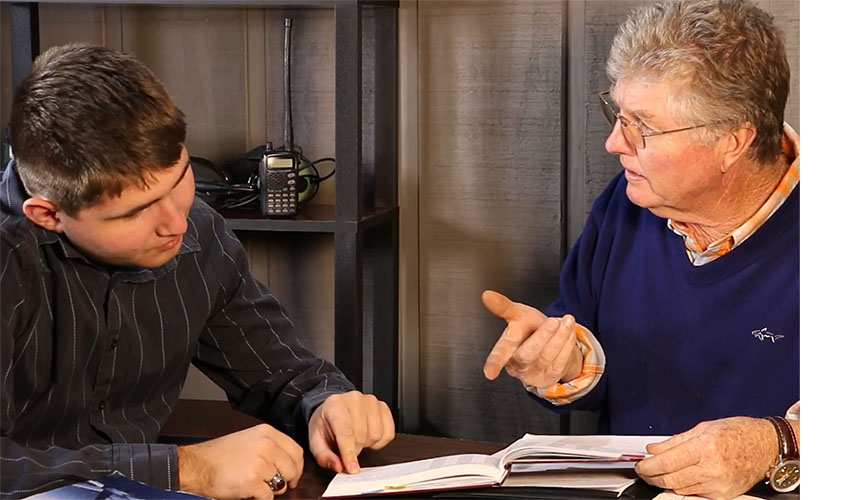
Imagine yourself sitting across the table from the DPE, or Designated Pilot Examiner. This person is a highly experienced pilot, and a flight instructor, too. He (or she) knows his stuff! The DPE will develop a dialog with you that requires you to answer direct questions, but also to discuss your rationale regarding scenarios you might encounter as a pilot. You aren’t going to bluff your way through this. The more you fumble around and exhibit your fancy footwork, the deeper the examiner will dig.
The Questioning Gets Difficult
No matter how well prepared you are, there are guaranteed to be questions that stump you to some degree. The examiner doesn’t expect perfect performance, but he/she does expect you to have a reasonable level of knowledge about every topic.
The rumor floating around in social media is this: you get stumped? No problem, look up the answer in the books. This is where the wheels start to come off the wagon.
Consider this question. You’ve been asked to list the flight instruments required for a VFR cross-country flight. Here are three ways this might go down.
1. You’ve memorized this and regurgitate them all correctly. Good job!
2. You recite most of them from memory, but forget one or two. You DO know the exact regulation about this, § 91.205, and go STRAIGHT to it in the FAR/AIM, quickly finding the ones you missed.
3. You know a couple of them, but struggle to remember more. You go to the table of contents in your FAR/AIM, and with some difficulty, you zero in on § 91.205 and read the answers from the book.
Number one is great. Number two is acceptable. But if you perform like number three in the list, this will be problematic. You might get away with it once, but perform to this level repeatedly, and your checkride will terminate prematurely, in a bad way.
How about another one? The DPE wants to know about airspace markings on the sectional chart. If you have to refer to the legend to correctly identify every one that is pointed out, that indicates a deficiency in your learning. Yes, you were able to find them in the chart legend, but some information is so basic (airspaces, for example) that you are expected to know it. Having to look up airspace markings makes the examiner question your level of knowledge. That’s never a good thing in a checkride.
Here is the bottom line. You may be able to look up some things in the appropriate references if:
1. You have a general understanding, but the questioning involves some nuance or unusual circumstance.
2. You have a general understanding and know EXACTLY where to go for official FAA guidance.
3. Your need to look things up is rare because you know your stuff!
Open Book or Not?
Looking things up because you simply don’t know them is never acceptable. The ACS is very clear about what you should know. Looking up the answers is not a tolerable substitute for knowledge.
So, back to the premise. Is the checkride oral an open-book exam? I hope you now understand why I say “sort of, but not really.”