Airspeed vs. Ground Speed: Sailing on a River of Air
by Jamie Beckett
Published
Updated
You’re no doubt familiar with the concept of the atmosphere being very much like a river of air. That is true. But the wind is a bit more mischievous than most rivers.
Rivers flow in one direction at more or less the same pace, day in and day out. The air does not. It’s unconfined and unpredictable.
While the Mighty Mississippi flows reliably south from Minnesota to Louisiana, the air above and around us constantly shifts this way and that. The velocity of the wind shifts, too. It may be nearly calm in the morning, but ramp up to a full-blown gale by dinnertime.
That ever-changing wind becomes a major factor in every aspect of our flying. Let’s consider a few examples of how the breeze either benefits us or hinders us as we make our way from Point A to Point B at the controls of the airplane.
What Is Wind?
Wind is simply a movement of air. Although it can be a localized movement, caused by solar heating or topography, large scale airmass movement also causes wind. But here’s the part frequently overlooked: wind is relative to the person experiencing it. If you are moving in the same direction as the wind, at the same speed, you won’t feel any wind at all. It will feel calm to you. Imagine that! A real-world application of simple physics.
Headwind Slows Us
In flight, the most obvious example is the effect of a headwind. A headwind is any wind that’s coming from somewhere in front of us, even if that wind impacts us at an angle. Conversely, a tailwind comes from any direction behind us.
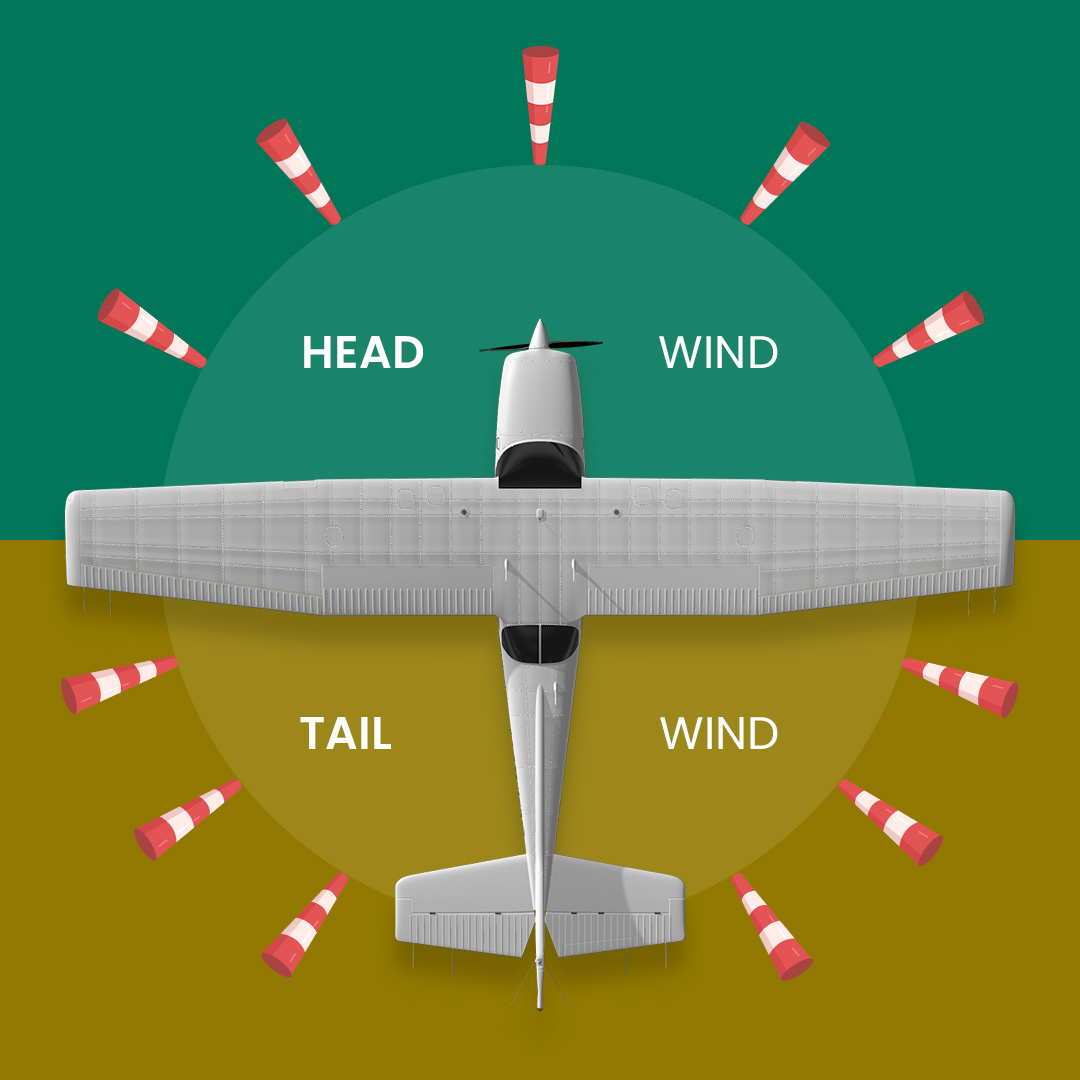 Regardless of the airspeed showing on our instrument panel, the headwind will slow our groundspeed. That same wind would increase our groundspeed if we reversed course.
Consider this. If we are flying directly to the east while we have an indicated airspeed of 100 knots, and the wind is out of the east at 10 knots, our ground speed will be reduced to 90 knots. Airspeed, minus the headwind component, equals groundspeed.
If that wind is 45 degrees off our nose, we will still see a reduction in groundspeed. But the reduction will not be the full 10 knots because we’re not flying directly into it. At 30 degrees off our nose, we will be slowed to a groundspeed of 91 knots with a fairly high headwind component. At 45 degrees we’ll slow slightly less because the headwind component is less. Our groundspeed will only drop to 93 knots.
The farther the wind is off from our heading, the less that headwind will affect our groundspeed.
Tailwind Speeds Us Up
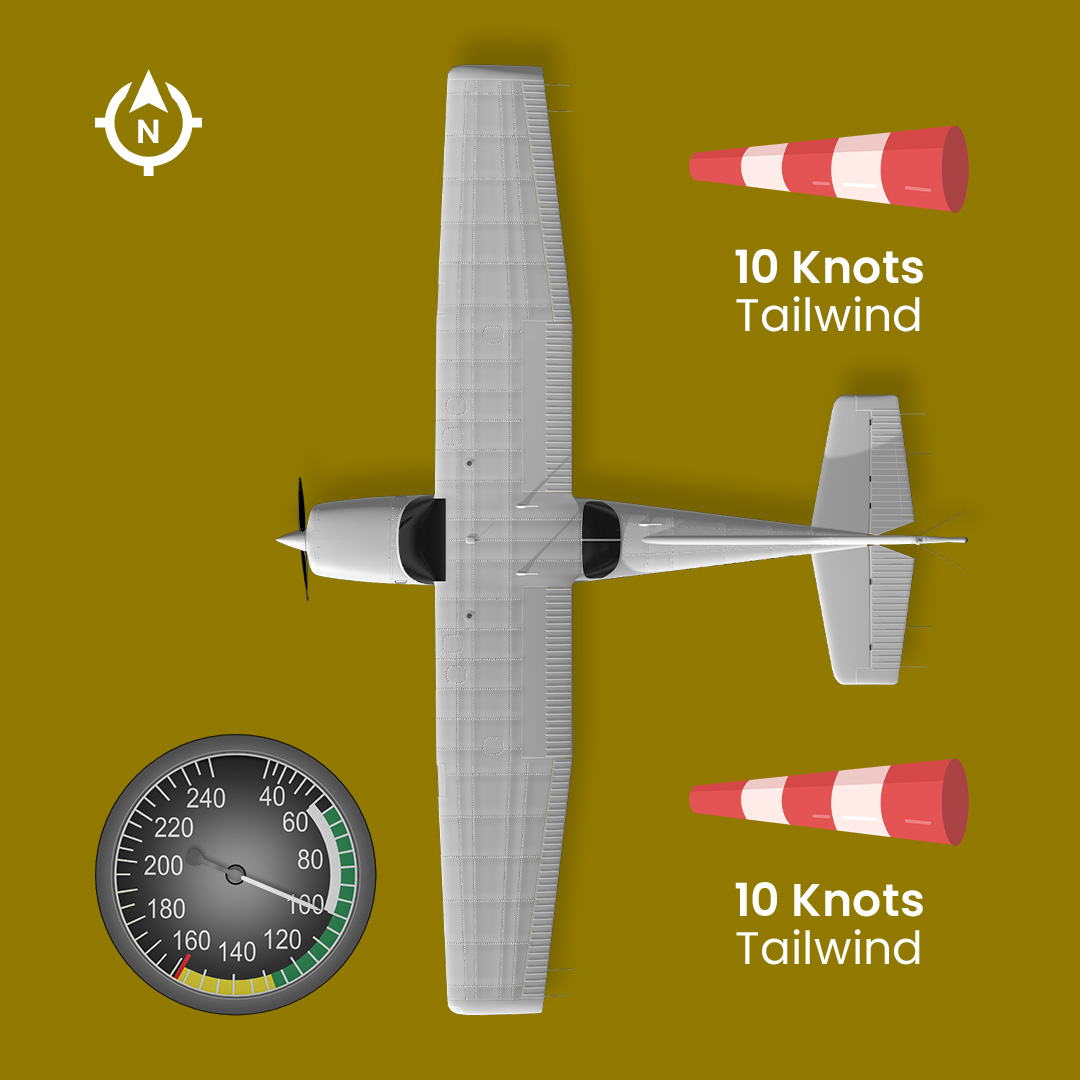
Now, for the good news. The exact opposite is true if we’re flying with a tailwind. If we were flying west with a 10-knot wind from the east, that wind is going the same direction that we are. It pushes us faster over the ground. Our groundspeed would increase to 110 knots, even though the airspeed indicator is assuring us that we’re moving through the air at 100 knots.
That’s a 20-knot difference in groundspeed from our track to the east compared to our track to the west.
From Point A to Point B
If our flight was 100 miles in each direction, the flight out to Point B (with a groundspeed of 90 knots) would take 67 minutes. The return flight, back to Point A (groundspeed of 110 knots), would take only 55 minutes. The flight out took longer because of the headwind, and the flight back was quicker because of the tailwind.
What About Gliding Distance?
Not only is our groundspeed slower, but our glide distance into the wind is shorter. In cruise flight, headwinds work against us. On landing however, a headwind is our friend. That headwind is giving us a slower groundspeed when we’re flying at our target airspeed for an approach to landing. We touch down at a slower groundspeed. A fact that gives us positive control at lower airspeeds. It also allows for a shorter stopping distance on the roll-out.
And while our cruising groundspeed is higher, our power-off gliding distance is longer with a tailwind. That’s a good thing if you find yourself gliding with an engine failure. Glide farther with a tailwind.
Wind’s Effect on Ground Track
Unfortunately, the wind is rarely directly on our nose or tail. If the wind is off to one side by even a few degrees we’re going to see a change in our ground track. Which is literally the path our airplane takes when drawn on the ground.
More good news, we can correct for that change in ground track by crabbing into the wind.
If we’re flying from Point X to Point Y on a course directly to the north, with a 20-knot wind from the east, the wind will push us to the west at 20 knots. Remember, that moving river of air is carrying us with it. If we don’t compensate for the force of the wind by crabbing our heading to the east, the wind will move us 20 nautical miles west over the course of an hour.
Yes, knots relate directly to nautical miles. Which means on a two-hour leg we could be pushed as much as 40 nautical miles off-course – if we don’t crab into the wind.
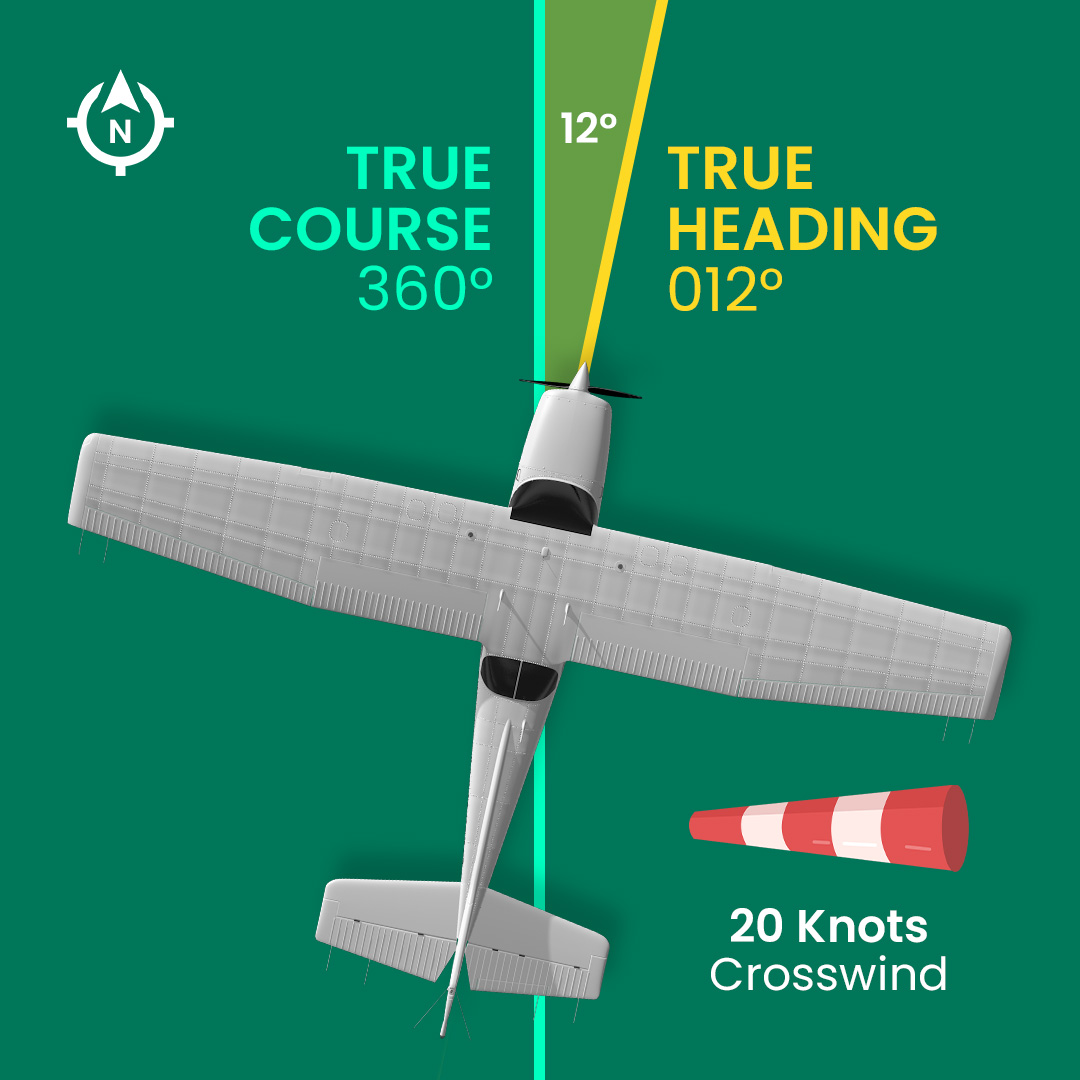
This is why we use our E6B. Both the analog whiz wheel version or a digital model will work wonders for you as you calculate a
n appropriate wind correction angle. A good rule of thumb is this; if the wind represents 10 percent of your True Airspeed (TAS), a 6-degree correction into the wind is required.
Using our northern course as an example with a 20-knot direct crosswind, we would point our nose (establish our heading) 12 degrees to the east. That should compensate for the wind drift to the west. Our ground track will continue to be 360 degrees, but our heading will be 012 degrees.
Final Thoughts
Remember that when you fly, you are moving forward based on your heading. But the airplane is also being carried by the airmass, possibly in a different direction. You have two motion vectors to consider: (1) the movement of the airplane within the airmass, and (2) the movement of the airmass, itself.
The effects of the wind can be managed. You have the tools. You have the knowledge. All you have to do now is put that knowledge and that skill to work.
As Captain Picard so often commands while on the bridge of the Enterprise: Make it so.
About the Author

Jamie Beckett came to aviation as a second career after taking a handful of flight lessons on a whim. He’s made general aviation his focus for more than 30 years serving as an instructor pilot, restoring WWII aircraft, writing for a variety of aviation publications, and flying just for the joy of it. Visit Jamie's channel at www.youtube.com/@MadPropsAero