Drone Flight Over People
by Russ Still
Published
Updated
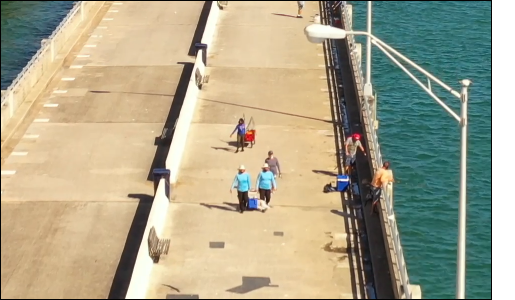
The ability to fly a camera over people opens up a lot of exciting possibilities for Remote Pilots. Prior to April 2021, this was only possible by obtaining a waiver and few were approved. That kept most Remote Pilots on the sidelines. Drone flights had to be carefully planned so that the aircraft never passed directly over anyone who was not a required crewmember directly involved with the flight.
Thankfully new rules (§107.39) opened up this practice. Remote Pilots mayfly their unmanned aircraft over people without waivers, under the proper circumstances. But the requirements for doing that are complicated and fairly restrictive. Qualifying to do this is not going to be easy.
The Four Categories
The FAA has created four new categories for sUAS aircraft. Each has different requirements. The most basic differentiations, and the ones you may be expected to know for a knowledge test, are listed here:
Category 1 - Aircraft weighs less than 0.55 pounds
Category 2 - Aircraft transfers no more than 11 foot-pounds of energy from a freefall (see §107.155 for compliance requirements)
Category 3 - Aircraft transfers no more than 25 foot-pounds of energy from a freefall (see §107.155 for compliance requirements)
Category 4 - Aircraft has an airworthiness certificate issued under Part 21 (not applicable to most small unmanned aircraft)
For Categories 1, 2, and 3, there may be no exposed rotating parts that would cause lacerations to human skin. This implies that contact with propellers must be prevented by housings or prop guards. Regarding transfer of energy upon contact, that is something that will most likely be addressed by manufacturers. It will be documented in the sUAS operating instructions and include a Document of Compliance obtained and provided by the manufacturer (under Part 107.160). This issue of flight over people is so nuanced that the FAA added an entirely new Subpart D under Part 107.
As you can see, nothing suggests that you're ready to take your DJI Inspire out for a video shoot over people. Your remote aircraft must legally fall into one of the existing categories. At this time, most off-the-shelf drones do not. It is a complicated issue, buried in a maze of regulations. But don't worry, it gets worse.
Over Humans - The Fine Print
For flights over people, there is yet another issue. How many people and for how long? That answer is based on which Category the UA complies with.
For Categories 1 and 2, regulations (Part 107 D) state that no remote pilot in command may operate a small unmanned aircraft in sustained flight over open-air assemblies unless the operation is compliant with Remote ID requirements (indicated in Part 89). This creates two more branches in the expanding hierarchy of stipulations. At the time of this writing, April 11, 2021, the technological requirements for Remote ID compliance don't even exist yet. Does that preclude flights over people right off the bat? And what constitutes "an open-air assembly"? If the people to be overflown constitute something less than an open-air assembly, are the Remote ID compliance issues even relevant?
For Category 3 aircraft, there is no operation over open-air assemblies at all. When operating a Category 3 UA over people, it must be within or over a closed- or restricted-access site and all people on site are on notice that a small UAS may fly over them. Does this still leave the loophole open for overflights of small groups while flying a Category 3 aircraft?
Remote ID Compliance
This one is difficult to resolve at this time. The FAA has not yet provided any guidance regarding flights over open-air assemblies during this period when RID compliance is simply impossible. Technically, it would seem that the RID compliance prohibits any ability to fly over open-air assemblies of people until RID technology has been finalized. That raises the question regarding the term "open-air assembly". It would appear that a Remote Pilot flying over people that are not part of an open-air assembly, by definition, might be unrestricted from RID compliance altogether.
So what is an "open-air assembly"? It was very difficult to find, but I have dug it out of the "Operation of Small Unmanned Aircraft Systems Over People - Final Rule" in the Federal Register, dated 1/15/21.
"The FAA has declined to define this term by regulation; rather, the FAA employs a case-by-case approach in determining how to apply the term 'open-air assembly.'
Whether an operational area is an open-air assembly is evaluated by considering the density of people who are not directly participating in the operation of the small unmanned aircraft and the size of the operational area. Such assemblies are usually associated with public spaces. The FAA considers some potential examples of open-air assemblies may include sporting events, concerts, parades, protests, political rallies, community festivals, or parks and beaches during certain events. Some potential examples that are less likely to be considered open-air assemblies include individual persons or families exiting a shopping center, athletes participating in friendly sports in an open area without spectators, individuals or small groups taking leisure in a park or on a beach, or individuals walking or riding a bike along a bike path, but whether an open-air assembly exists depends on a case-by-case determination based on the facts and circumstances of each case.
The remote pilot must assess whether the operational area would be considered an open-air assembly prior to conducting flight operations."
This does appear to indicate that flights over individuals and small (another relative term) unrestricted groups may be performed by unmanned aircraft in Categories 1 and 2 without regard to RID compliance.
But Category 3 injects a further detail in §107.125 (Category 3 operations: Operating Requirements). This part of the rule says that, everything else not withstanding, flight over unprotected people must be within (or over) "a closed or restricted-access site and all human beings located within the closed or restricted-access site must be on notice that a small unmanned aircraft may fly over them."
The Knowledge Test Dilemma
Another new rule released at the same time allows night operations without a waiver after completing an (updated) Part 107 knowledge test/training (initial or recurrent) after April 5, 2021. This is explicitly referenced in §107.29 (a)(1) (which further references §107.73). The recurrent course and test is offered for free at FAASafety.gov. The course is labeled ALC-677.
Oddly enough, §107.39 makes no similar statement regarding training or testing for flight over people. Remotes Pilots must know about the Categories and other related rules, but are not required to pass a knowledge test or take training to fly over humans. This precise topic is clearly spelled out in the Remote Pilot ACS dated April 2021. (See link in sidebar.) It may be covered in knowledge tests, but again, passing such a test is not a requirement to operate under Part 107.39.
Summary
The new FAA rules implemented in April 2021 have made it possible for Remote Pilots to fly sUAS aircraft over unprotected people without obtaining a waiver. The new rule divides small unmanned aircraft into four categories, each with different requirements. It is unlikely that existing drones can qualify for any of these categories at this time. The actual rules for operation over people vary from one category to the next. And at this point, it is not yet crystal clear how to comply in every case.
So, are you now legal to fly over humans without a waiver? It's highly unlikely.
Unfortunately, we are going to have to wait for further FAA guidance on this one, and possibly a legal interpretation from the FAA General Council in Washington, DC.