Your 2-Year Drone License Renewal
by Russ Still
Published
Updated
There is one question that keeps coming up among drone pilots. What if my license (properly known as a "certificate") expires? There is a very short answer: your remote pilot certificate does not expire. It is good forever.
However, even though it never expires, you must renew it every two years in order to "remain current" and continue flying under Part 107. That is done by taking an FAA written exam called the Recurrent Test. The renewal/recurrency period starts on the date of your last test and extends to the end of that month, two years later.
If you haven't taken a Recurrent Test within 24 calendar months of your previous test (be it Initial or Recurrent), nothing bad happens to you. You simply may not fly under Part 107 until you take the Recurrent test. There is no penalty for going past 24 months.
New Rules and New Capabilities - April 2021
In 2021, several FARs (Federal Aviation Regulations) were changed with regard to Remote Pilot flight operations. The primary changes referred to (1) flight during night hours, (2) flight over people, and (3) Remote ID. My apologies in advance - it can be confusing and is riddled with dates. Don't shoot me. I'm just the messenger.
There is a big improvement to the process. The Recurrent course and test (ALC-677) can be taken online and at no charge at FAASafety.gov. The link is in the sidebar.
The course, itself, takes a bit over an hour to complete. After that, you must score 100% on the Recurrent test. It's not difficult since it highlights your wrong answers and allows you to correct them. Once you have completed the course and test, the system will generate a certificate confirming your recurrency and you are good for another 24 calendar months.
Here are the main topics covered in the Recurrrent course and test:
● Night Flight Operations
Previously, the only way to fly your sUAS at night was to receive a wavier from the FAA for the regulation that prohibited night flight. Without that waiver, you were still legal to fly during "evening civil twilight" and "morning civil twilight" as long as your aircraft was equipped with anti-collision lights that were visible for three miles. But for that dead-of-night period sandwiched between the two civil twilight periods, you had to have a waiver.
The new regulations now allow you to operate between sunset and sunrise without a waiver. BUT, you must receive additional training in night flight operations after April 5, 2021 and pass either an Initial or Recurrent FAA knowledge test for Remote Pilot. With that, you are good to go for night flight.
During all operations between sunset and sunrise, your sUAS must be equipped with anti-collision lights that are visible at least three miles away.
● Flight Over People
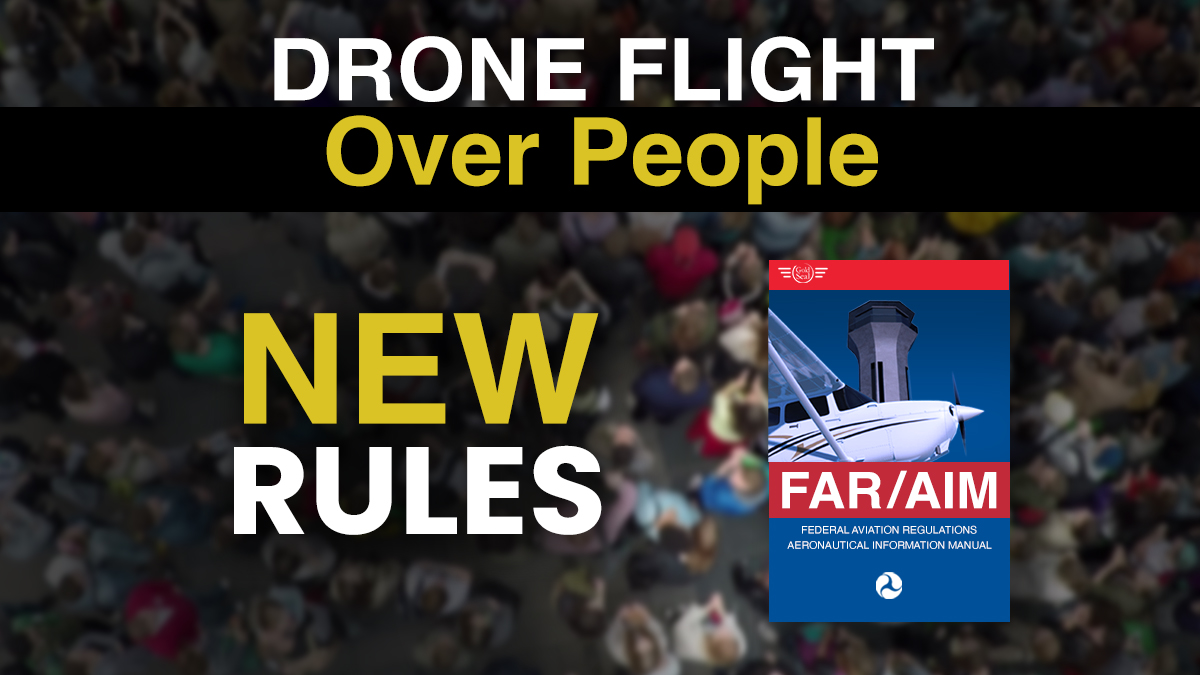
Being able to fly over unprotected humans provides Remote Pilots with some remarkable possibilities. However, this type of videography carries significant risk to the people below. Prior to April 2021, this type of flight was only allowed by waiver and those waivers were exceedingly difficult to get. Now, as with night flight, things have changed. But it's a good news/bad news situation.
The good news is that you may now fly your drone over people without a waiver.
The bad news is that there are major restrictions. The restrictions may be impossible to comply with using most drones manufactured prior to April 2021.
sUAS aircraft are now divided into four categories. These are defined by a combination of weight and the amount of energy transfer that would occur if the drone suddenly dropped from the sky. In most cases, these are going to require a manufacturer redesign and FAA compliance documentation.
Refer to the article listed in the sidebar for more information.
● Remote ID
Manned aircraft use transponder technology to broadcast their positions. Air traffic controllers can see this on their radar and using some additional technologies, such as ADS-B, other pilots may also be able to see the traffic too.
Remote ID is a new, and as-yet, incompletely defined technology. It specifically does NOT include conventional aviation transponders and/or ADS-B. The technology and its use fall under FAR Part 89, but will not take effect until 2023. An introduction to this requirement is covered in Initial and Recurrent FAA Remote Pilot knowledge tests after April 5, 2021.