MSA vs. TAA - A Checkride Gotcha!
by Russ Still
Published
Updated

You don’t need to have an upcoming instrument checkride to learn the nuances of symbols on an approach chart. One example that frequently confounds applicants, however, involves the differences between these two graphics, both from approaches into Lincoln, Nebraska. One, and only one, of these will appear on every instrument approach procedure chart. And though they look somewhat similar, they are very different.
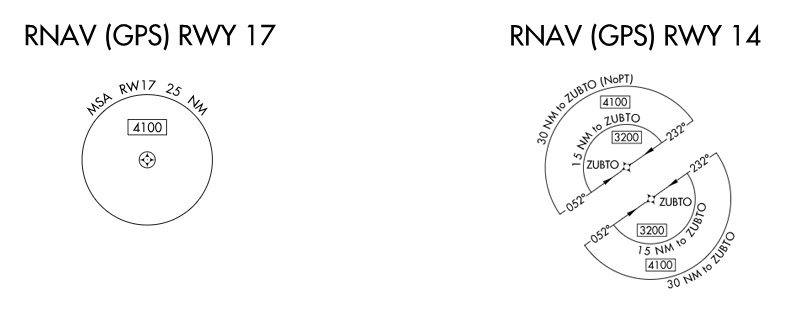
Take a moment and compare the two images. Imagine that your DPE has asked you to describe the use of each one in detail.
Chart Symbols You Haven’t Thought About.
But Your Examiner Has…
The symbol on the above-left refers to the Minimum Safe Altitude. In ICAO parlance, it’s the Minimum Sector Altitude. They’re slightly different names, for the same thing. The MSA is always labeled as such. Note the “MSA” atop the symbol for RWY 17 approach. This is the one sure-fire way of distinguishing an MSA from a TAA, which, by the way, is coming up next.
The symbol on the right for the RWY 14 approach is the TAA. Just to muddy the water, there are three different uses of TAA for FAA abbreviations. In this case, used with this or similar symbols, it refers to the Terminal Arrival Area altitudes. (See the Instrument Procedures Handbook, Chapter 4.)
So, we’re talking about two altitudes here: the MSA and the TAA. But that’s where the similarities end.
The MSA Symbology
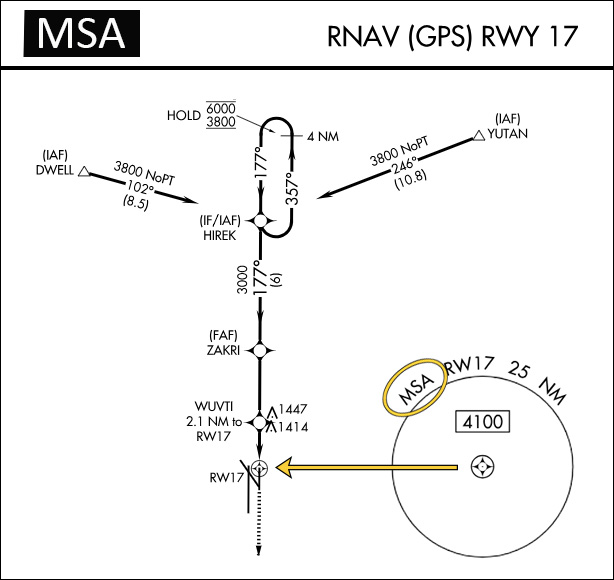
The MSA shows you a minimum altitude that is safe from obstructions within a specified radius from a fix or NAVAID. This is generally 1000 feet of clearance, but may be 2000 feet in some mountainous areas. The MSA is useful in the case of an emergency such as an equipment failure including lost communications.
This symbol indicates that the MSA of 4100 feet MSL exists within a 25NM radius of the RW17 fix, in all directions. That is the runway threshold.
There are many examples of MSAs that are not just simple, undivided circles, like this one. They may indicate different safe altitudes in different quadrants.
The TAA Symbology
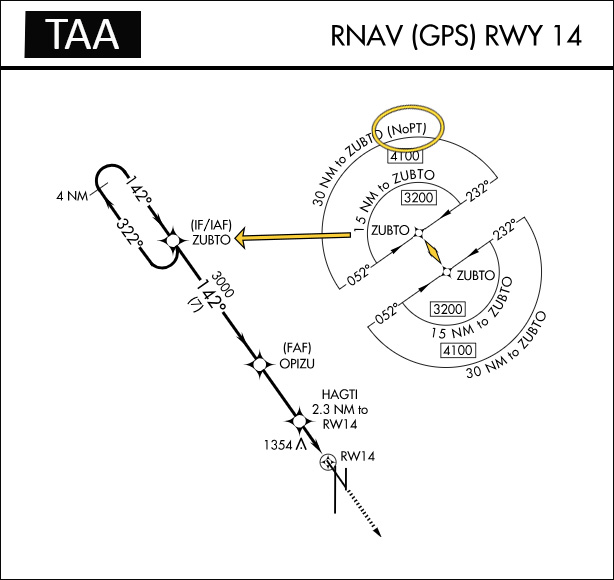
The TAA (Terminal Arrival Area) shown below provides two radii from the ZUBTO initial approach fix. It is divided into two halves (sectors). One is northwest of ZUBTO and the other is southeast. This example is simple, having the same altitudes specified in both halves. Frequently, though, the altitudes will be different.
If you are between 30 and 15 nautical miles from ZUBTO and have received an approach clearance, you may proceed down to 4100 MSL during normal operations. But you must have an approach clearance to do this.
Likewise, if you’re 15 miles or closer to ZUBTO with an approach clearance, you may descend to 3200 MSL.
Even though the two halves of this symbol show mirror images of the altitudes, there is one significant difference. Note that the top half of the TAA, for aircraft inbound from the northwest, has a NoPT designation. (It's circled in yellow.) This means that, regardless of your altitude, if you are inbound from the northwest, no course reversal is authorized. If, for example, you wanted to lose some altitude in the hold, you would need permission from the controller because of the NoPT notation.
In this example, a pilot arriving from the northwest would not have to worry whether he/she was "cleared straight in" or was being vectored. The NoPT designation makes it clear that no procedure turn (course reversal) is authorized or expected.
If you were inbound from the southeast, it’s a different story. Note that the lower half circle makes no mention of NoPT. Unless the controller was vectoring you to the inbound course, or he/she specified “straight in” in the approach clearance, you would be required to do the course reversal starting at ZUBTO.
Summary
MSA and TAA both provide at least 1000 feet of obstacle clearance. Even though the symbols may look similar and one or the other will appear on every approach chart, there are some major differences between the MSA and TAA.
- MSA stands for Minimum Safe Altitude and is for use during emergencies.
- TAA stands for Terminal Arrival Area. Based on your bearing to the indicated fix, it provides optional descent altitudes that may be used once you have received an approach clearance. And watch for the NoPT notation.