Class E and G Airspace: No More Confusion
by Ryan Thomas
Published
Updated

If you’re not a beginner now, I’m sure you remember when you were. And I suspect you remember being overwhelmed with the National Airspace System, particularly the lettered airspaces. There were standard volumes and shapes to remember, rules for operation, weather minimums, and sectional chart depictions.
There was a lot of stuff, and there still is.
In the olden days, pre-1993, lettered airspaces didn’t exist in the United States. They were known by acronyms such as PCAs, TCAs, ARSAs, and ATAs. I’d argue that the newer lettered descriptors are easier to learn. It at least keeps them in a hierarchy.
For new students, the two that seem to cause the most confusion are Classes Echo and Golf. They’re somewhat similar but, the fact that one is controlled airspace and the other is not can cause students a lot of grief.
Controlled versus Uncontrolled
 So, what exactly does that even mean? The most simple explanation states that ATC, Air Traffic Control, controls all lettered airspace except Class Golf. G is the only uncontrolled airspace in the National Airspace System.
In controlled airspace, you can receive radar services in the form of Flight Following, you can fly under an IFR flight plan, and you may interact with controllers in Class Bravo, Charlie, and Delta.
In uncontrolled airspace, Class G, none of these options are available. There are still rules and regulations, but you’re largely on your own.
Now, Class E airspace. Unlike Class Golf, Class Echo is controlled airspace. In fact, on your cross-country flights below 18,000 feet, most of the time you’ll be flying in Class E. On Flight Following or an IFR Flight Plan, too, I hope.
What Differentiates Class E from Class G?
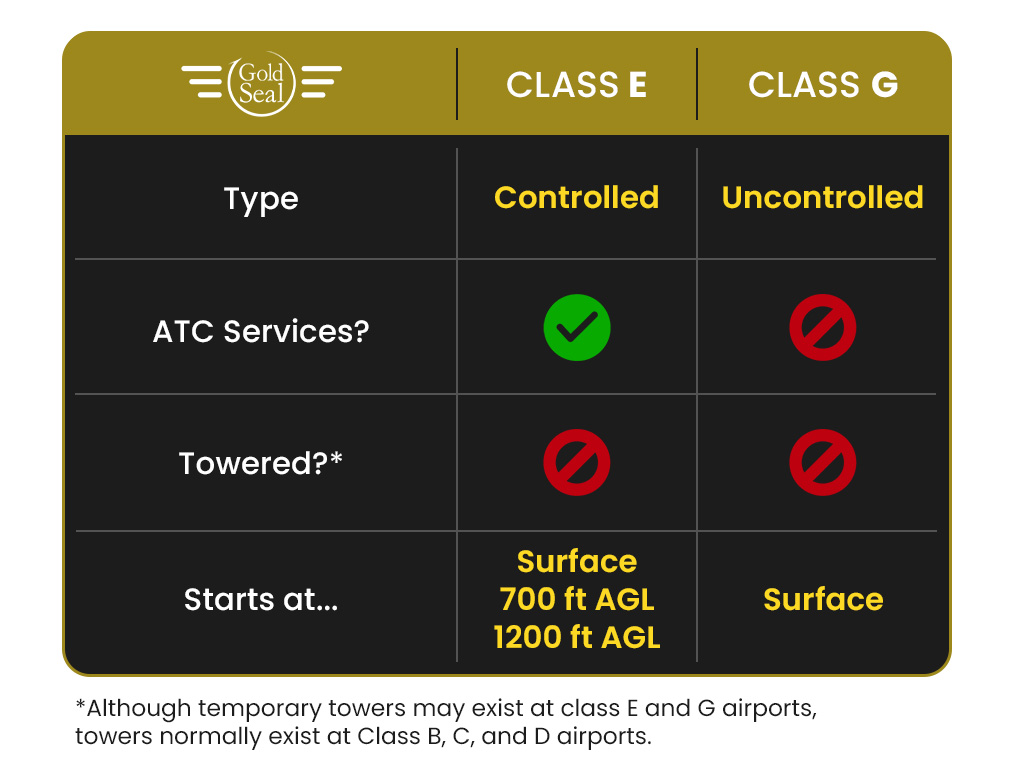
First of all, as we just saw, Class E is controlled, and Class G is uncontrolled. You can get ATC services such as Flight Following in Class E, but not in Class G.
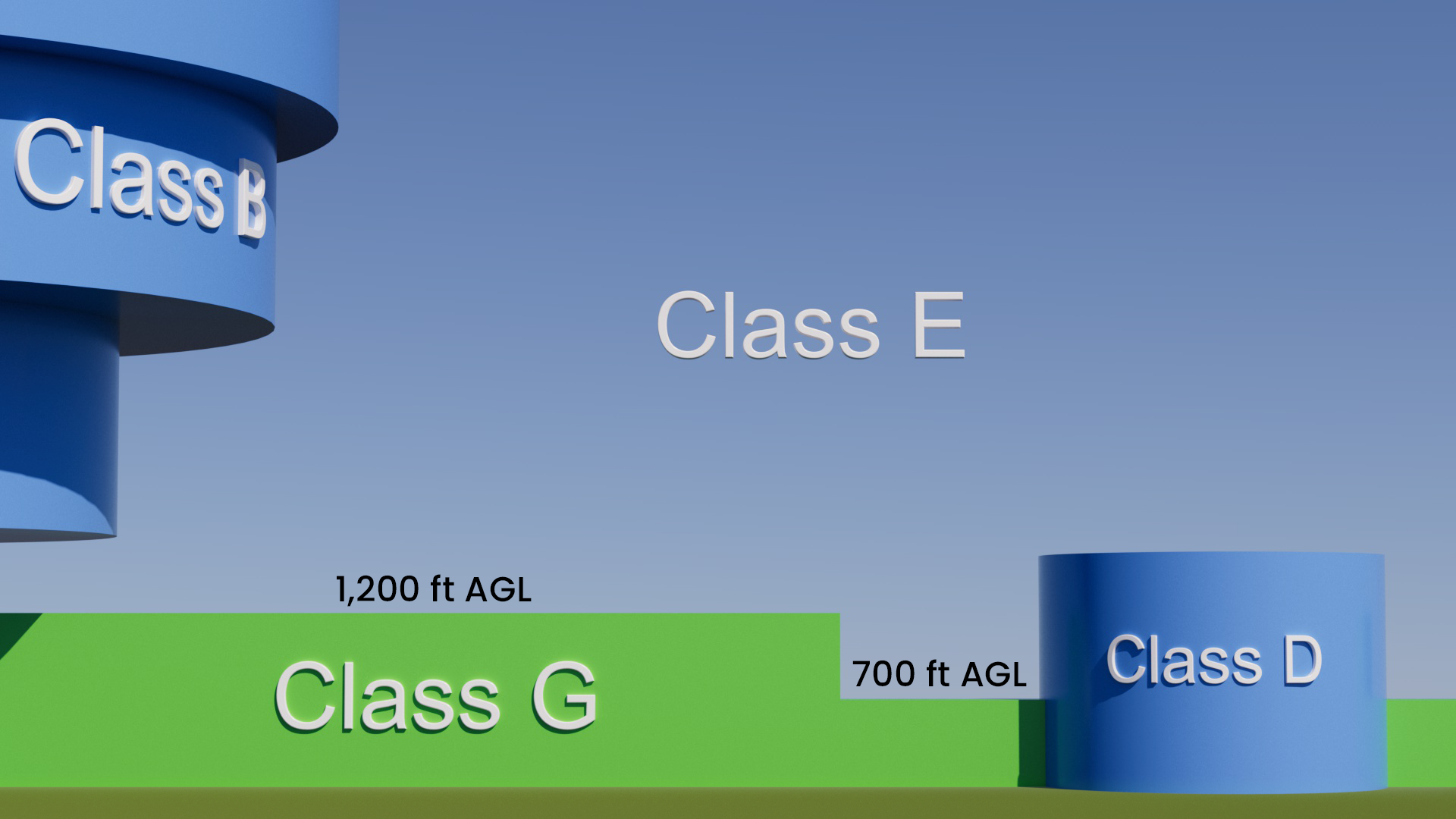
Class G always starts at the surface. No exceptions. Class E may start at the surface, but in most cases, it starts at either 700 feet AGL or 1,200 feet AGL.
Both Echo and Golf climb vertically until they abut another lettered airspace above. Most of the time, Class G climbs until it hits Class E. And Class E climbs until it hits Class A at 18,000 feet MSL.
Class G and E also have differing VFR requirements. Review these in the Gold Seal Private Pilot Ground School lesson on VFR Minimums in Section 4.
Airport Airspaces
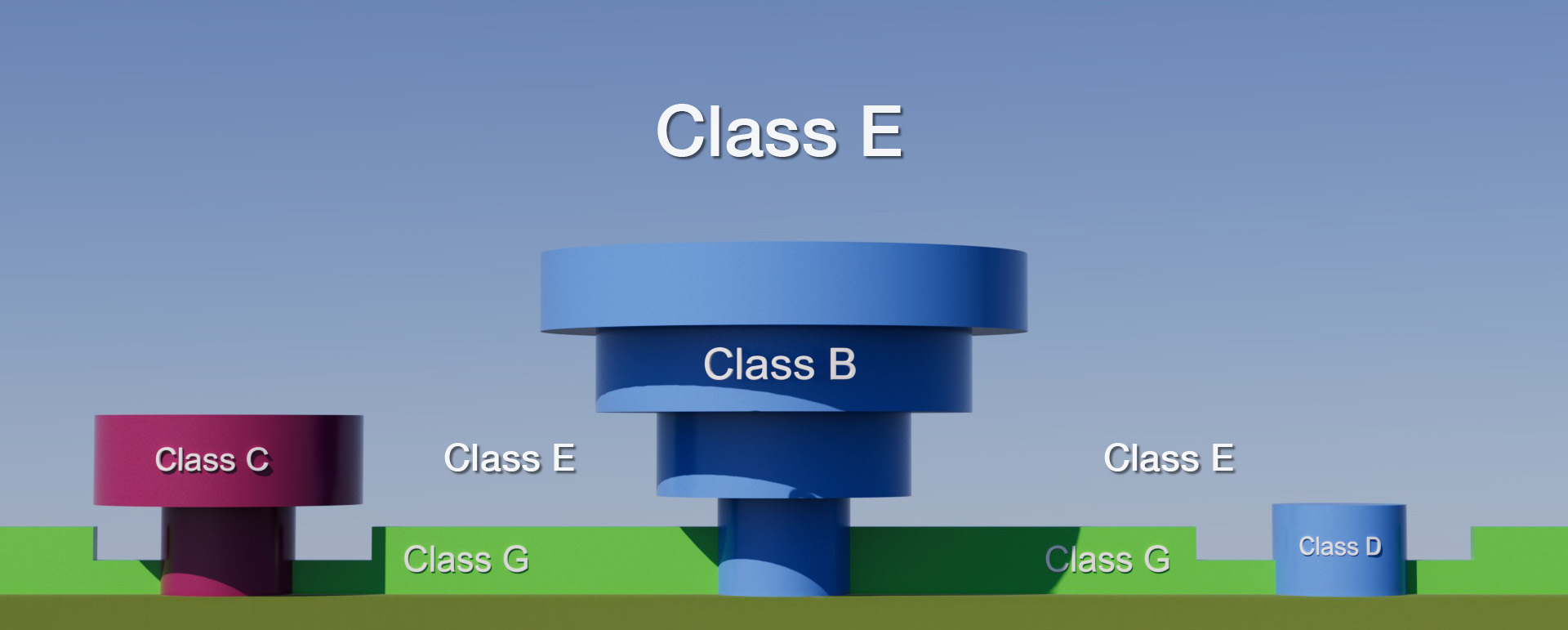
As you already know, Classes Bravo, Charlie, and Delta surround airports. Bravo airspace is frequently described as in inverted, multi-layer wedding cake shape. Class Charlie is like a smaller inverted cake, generally with just two layers. And Class D is shaped like a cylinder or a drum.
Now imagine that these B, C, and D airspace volumes are solid and placed into an empty aquarium. Pour in some water at the bottom and that would represent the Class G, starting at the floor. It would be obvious that the Class G filled in the areas between the lower portions of the B, C, and D airspaces.
Where the watery Class Golf stops, assume that this is the bottom of Class E at 1,200 feet AGL, also filling in the empty spaces. This leaves the aquarium completely filled with lettered airspaces, each one of them discreet and separate, fitting together like a 3D puzzle.
On the Sectional Chart
Everyone can recognize Class B, C, and D airspaces on the sectional. Class Bravo is defined by a solid blue line, Class Charlie by a solid magenta outline, and Class Delta is outlined with dashed blue. All three of these are towered airport airspaces.
Class E airspace, that airspace the fills in the gaps between B, C, and D, generally has no markings. You just have to remember that it normally starts at 1,200 feet AGL. At that altitude, if it’s not Bravo, Charlie, or Delta, it’s Class Echo.
If the airspace is controlled and not B, C, or D, it’s E - everything else. And that’s a great memory aid. Class Echo is everything else.
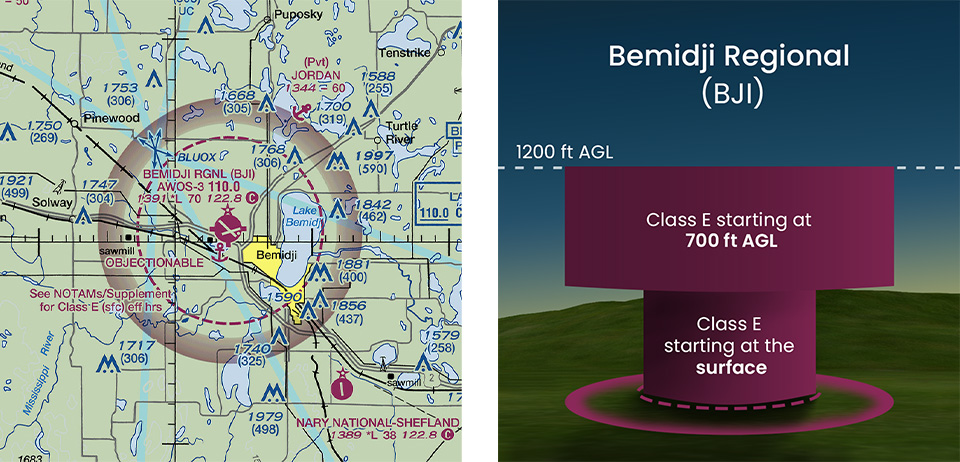
Occasionally, Class Echo may start lower, at either 700 feet AGL, or the surface itself. When it starts at 700 feet, it is marked on the chart with a shaded magenta outline. Since Class E is controlled, this means that pilots may remain under ATC for an additional 500 feet when approaching some airports.
If an airport is surrounded by the 700-foot shaded magenta outline, but it’s NOT in Class B, C, or D, there may be another outline showing that the Class E goes all the way to the surface. This would be a dashed magenta outline.
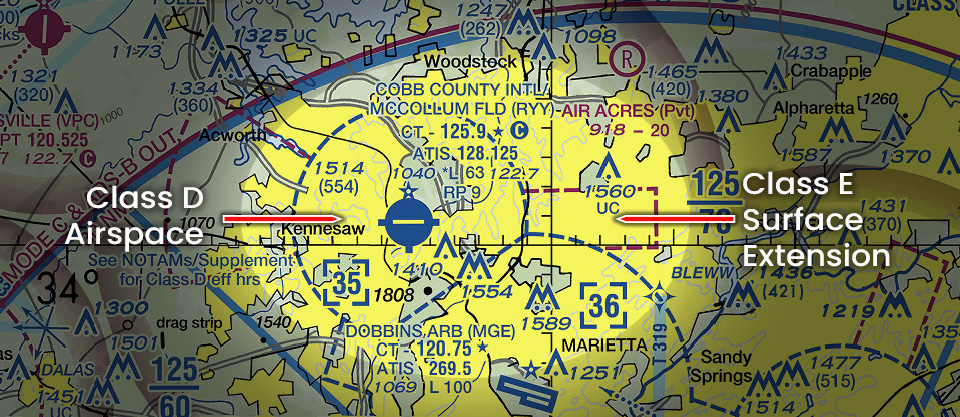
Some Class D airports show a rectangular dashed magenta area outside of the Delta airspace. This is a Class E surface extension, and again, is there so that inbound traffic can remain under the control of ATC in the lower parts of their descents.
Class Golf airspace, as we noted, is uncontrolled. It always starts at the surface, and extends vertically until it abuts another airspace, usually B, C, E, or even Class A.
There are no markings on the chart to show Class G. Just recall that it starts at the ground and extends upward to the next airspace above it. And that is usually Class E at 1,200 feet.
The Summary
So, both Class G and Class E tend to fill in the gaps between B, C, and D airspace.
Class G is uncontrolled, and Class E is controlled. And you know what that means.
Class G always starts at the surface. Class E sometimes starts at the surface, but usually starts at either 700 feet, or 1,200 feet.
There are markings on Sectional Charts to show some boundaries that separate G and E. Know that Class E always exists at 1,200 feet, unless that space is already taken by Class B, C, or D. There are no markings to show this. You just have to know it.
A shaded-magenta outline indicates a 500-foot dip in the Class Echo. Where this shaded outline appears, the Class E drops down to 700 feet. And if there is a dashed magenta outline, well, this identifies where Class E goes all the way to the ground, and there is no Class G at all.