Time Building - Can You Split Time and Expenses?
by Jamie Beckett
Published
Updated
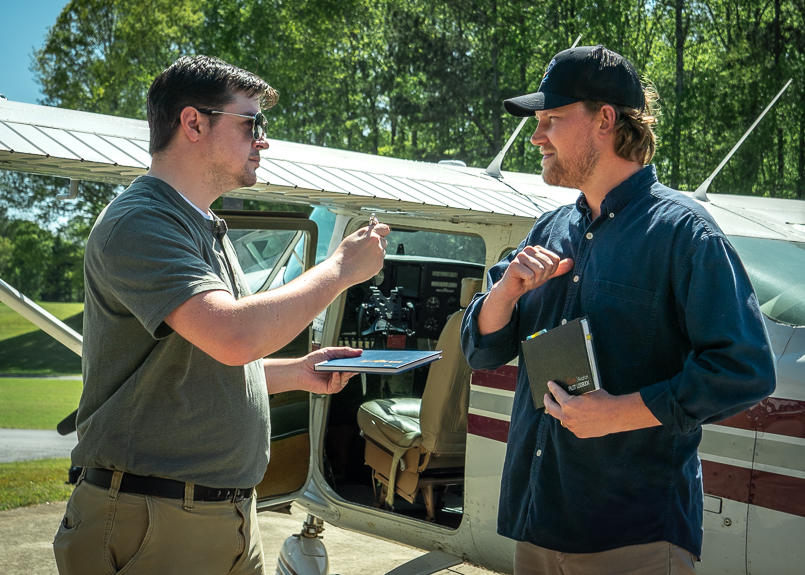 We all want to "build time", right? This results in a dilemma that is common among pilots.
Is it possible and legal to for both occupants of a light general aviation single engine aircraft to log PIC time when flying together? The answer to that question may surprise you. It is an emphatic, maybe.
What you cannot do, however, is to fly around with your buddy in a rented 172, no one under the hood, and both of you log the time, while paying half of the rental cost.
Rules are rules
The FAA has established strict standards for logging flight time. As pilots it is critically important that we log our time accurately. There is even a regulation that requires us to be careful in our record keeping. 14 CFR 61.59 is actually called, “Falsification, reproduction, or alteration of applications, certificates, logbooks, reports, or records.” The length of the title alone gives us a glimpse into how seriously the FAA takes this issue. In fact, the cost for playing fast and loose with our logbook entries could be as severe as suspension or even revocation of our pilot certificates and ratings.
Defining the PIC
Knowing that running afoul of the regulations is not in our best interest, we can deduce that logging PIC time has to be done with great care. Fortunately, the Code of Federal Regulations clarifies the term in 91.3 where it reads, “The pilot in command of an aircraft is directly responsible for, and is the final authority as to, the operation of that aircraft.”
If you read that sentence carefully, you’ll notice it says nothing about the PIC being the sole manipulator of the controls. It doesn’t stipulate the PIC has to be in the left seat, either. It simply says the PIC is responsible for the flight and has the final authority in regard to the flight’s operation.
Shades of Gray
When a pilot is the sole occupant of the aircraft, we can be fairly certain that he or she can legally and ethically log their time in the PIC column of their logbook. However, during training flights with a CFI we are not solo, yet a private pilot flying with a CFI in pursuit of their commercial certificate can correctly log PIC time, because they are the sole manipulator of the controls. The CFI can also log PIC time because they meet the definition provided by 91.3 as being responsible for and the final authority of the flight.
And this is where things get interesting for those of us who might wish to maximize our flight time while cutting back on our time building costs. A window of opportunity exists due to another regulation. You can find this ruling in 14 CFR 61.51(e), “Logging pilot-in-command flight time.”
The Word
Our regulatory guidance starts out plainly enough, “A sport, recreational, private, commercial, or airline transport pilot may log pilot in command flight time for flights –“
“When the pilot is the sole occupant in the aircraft.” Yes, we were pretty solid on that already, but it’s nice to have official confirmation.
This next bit is where we find a far more interesting clarification. “When the pilot, except for a holder of a sport or recreational pilot certificate, acts as pilot in command of an aircraft for which more than one pilot is required under the type certification of the aircraft or the regulations under which the flight is conducted…”
That line is a little wordy perhaps, but it opens up a whole new means of building flight time as PIC for those of us who are loyal and dedicated to the letter and spirit of the word.
Correlation is Key
You might guess this regulation doesn’t apply to us if we’re flying a Cessna 172, or a Piper Archer, or a Beech Bonanza. None of those aircraft require a second pilot as part of their certification. But, and this is a big but, the specific flight you’re conducting may very well require a second pilot even if it is performed in an aircraft that is approved for single pilot operation.
Again, we go to the regulations to seek our accurate, thoroughly defensible answer. In this case we find that information in 14 CFR 91.109, “Flight instruction: Simulated instrument flight and certain flight tests.”
91.109(c) stipulates that “No person may operate a civil aircraft in simulated instrument flight unless…The other control seat is occupied by a safety pilot who possesses at least: a private pilot certificate with category and class ratings appropriate to the aircraft being flown.”
The Upshot
You might think we’ve plowed through a long list of rules and regulations in search of a clear definition of what Pilot in Command really means. In truth, we’ve done far more than that. We’ve potentially found a way for you and your fellow air-people to earn flight time for half the cost.
See if you can follow along with this line of reasoning. The "pilot flying" is pilot in command and is responsible for the flight as its final authority. He or she is the sole manipulator of the controls. When he is flying under the hood, and a safety pilot is a required crew member, the safety pilot can legally, ethically, morally, and with a clear conscience log PIC time for those hours and minutes when the sole manipulator of the controls is flying by reference to instruments alone. The pilot at the controls needs YOU as the safety pilot, vigilantly scanning the skies for birds, airplanes, and any other nasty surprises.
Legally Splitting Time - A Scenario
In practical terms this is what that flight might look like. Cheryl and John are both private pilots. Each is working toward their instrument rating with a separate CFII. But Cheryl owns an airplane and would like to build her flight time and ability to fly by reference to instruments alone. Yet, to fly under the hood she will need a safety pilot to accompany her. It’s a rule after all.
John agrees to fly with Cheryl and act as her safety pilot. They brief before the flight. They agree that after departure, when the tower approves them to change frequencies, Cheryl will begin flying with a view limiting device. She’ll be simulating instrument flight on their cross-country jaunt from Point A to Point B.
They also agree that John will handle the radio work while maintaining a collision avoidance scan.
Two important things are happening simultaneously. Cheryl and John are learning to work as a crew. They’ve divided the required duties and are both taking responsibility for specific tasks. Secondarily, they have created a situation where Cheryl can get her simulated instrument practice in flight, while logging PIC as sole manipulator of the controls. As a bonus, John can log PIC time as a required crew member in accordance with the regulations for the time Cheryl is under the hood.
Because the FAA allows pilots to share costs with passengers on a pro-rata basis, it would be entirely acceptable for John and Cheryl to split the fuel cost of their flight. Cheryl would be able to log PIC time for the entire flight. John would be on solid ground logging PIC time for the portion of the flight when Cheryl was under the hood. Both would undoubtedly learn something of value on the flight and increase their own confidence in their ability to fly with precision while operating as part of a crew.
But what about…
If Cheryl’s airplane is a high-performance machine John would have to hold a high-performance endorsement as well to log PIC time for the flight. If he doesn’t have such an endorsement, all is not lost. The flight can still go on as described above, but John would log his time as Safety Pilot in the Second in Command column of his logbook. His role was a requirement of the flight, and his time can be logged appropriately to reflect his participation.
Logging as a Required Crew Member
Yes, you may be able to log PIC time as a private pilot when you’re acting as a safety pilot for another pilot flying while wearing a view-limiting device. But we started this journey with the acknowledgement that accuracy is important. With that in mind, be cautious to only log flight time for that time actually spent acting as a required crew member, in this case serving as a safety pilot. The pilot flying was probably not "under the hood" during takeoffs and landings, so a safety pilot isn't needed during these phases of flight.
If Cheryl is logging 1.5 hours of PIC time for a flight where she flew a few approaches under the hood, the safety pilot may be able to log 1 hour. If you get off the ground quickly it may be possible to log as much as 1.2 hours. Be conservative in that logbook entry, however. There may come a day when you’re asked to justify the time reflected by your logbook entries. We would not like to be tasked with explaining why we logged 1.5 hours of safety pilot time on a flight that was 1.5 hours long.
“And how do you believe you served as a required crew member of a Cessna 152 during start-up and taxi, landing and shut-down, exactly?”
Gulp.
About the Author

Jamie Beckett came to aviation as a second career after taking a handful of flight lessons on a whim. He’s made general aviation his focus for more than 30 years serving as an instructor pilot, restoring WWII aircraft, writing for a variety of aviation publications, and flying just for the joy of it. Visit Jamie's channel at www.youtube.com/@MadPropsAero