Radio Communications Are Established. Or are they?
by Jamie Beckett
Published
Updated
Airspace comes in various shapes and sizes. Often, student pilots put great emphasis on learning the dimensions and locations of Class A, B, C, D, E, and G airspace. As they should. But in the real world, there's a bit more to know.
When embarking on this educational journey it’s worth noting that Class A, B, C, D, and E are all controlled airspace. G is the only uncontrolled airspace of the bunch. For the moment, let’s focus on B, C, and D airspace. The common link between each of these is fairly obvious, but critically important. They all define airspace that surrounds an airport with a control tower, that you might like to visit.
Entering the Airspace
Another commonality between these three controlled airspace classes is that each requires the pilot to establish two-way radio communication before operating within the confines of the controlled area. This is true whether you intend to enter the airspace from the air on arrival, or from the ground on departure.
That one word, “establish” catches far too many pilots off guard. Simply tuning in the appropriate frequency, pushing the button and stating your intentions in a low, growly voice that approximates that of a senior captain at the airlines, does not qualify as two-way radio communication.
Two-way radio communication is specifically established when the pilot calls ATC and ATC responds using the aircraft call sign, or N-number. That’s not an idle opinion, either. You can find a good reference for this in AIM 3-2-5,b. It reads, “If the controller responds to a radio call with, ‘(aircraft callsign) standby,’ radio communications have been established, and the pilot can enter the Class D airspace.” Of course, the pilot should be expecting further communication before entering the traffic pattern. But the callsign was heard, so the gates into the Class D have been opened.
The key to this is that ATC used the aircraft’s callsign, or N-number in their response. Had the tower said, “Aircraft calling KABC tower please standby,” radio communication was NOT established. The determining factor is all about the pilot hearing their callsign, regardless of what the instruction from ATC might have been.
Let’s take it a step further. Consider this example. An aircraft calls in to a Class D tower reporting its position as 8 miles east. If the controller responds, “Aircraft eight miles east, continue”, communications have NOT been established. The tower controller left out the airplane’s callsign. Even though the controller said to continue, the lack of the callsign indicates that entry into the airspace had not yet been approved. Continue on, but don’t enter the airspace without establishing communications.
In Class D airspace, “communications established” is the rule. And it’s a rule worth knowing well. Nobody needs to experience the excitement of entering controlled airspace without tipping off the controllers first. That’s super important regardless of which type of controlled airspace you might be planning to fly through.
Straying into an airspace without following the rules can get you into a world of trouble. For more details, view the lessons “Class D VFR Arrival” and “Class D VFR Departure” in the Gold Seal Private Pilot Ground School in Section 2.
Airspace Complexity
Class D is the simplest of the controlled airspaces surrounding a towered airport. The only requirement to enter Class D airspace is to establish two-way radio communications. And now that you know exactly what that means, you’re good to go.
Class C and Class B, however, are both larger and busier. Frequently, substantially so. They contain more diverse aircraft (especially high performance or transport category aircraft) and have more strict entry requirements. Yet, each of these controlled airspaces share some commonalities that will make it easier for any pilot to view the building blocks that lead from the oh-so-simple D airspace to the sometimes intimidatingly complex Class Bravo.
Here Are the Rules
Class D airspace requirement: two-way radio communication (with tower controller).
Class C airspace requirements: two-way radio communication (with approach controller), plus the aircraft must be equipped with a Mode-C transponder, and an operating ADS-B Out unit.
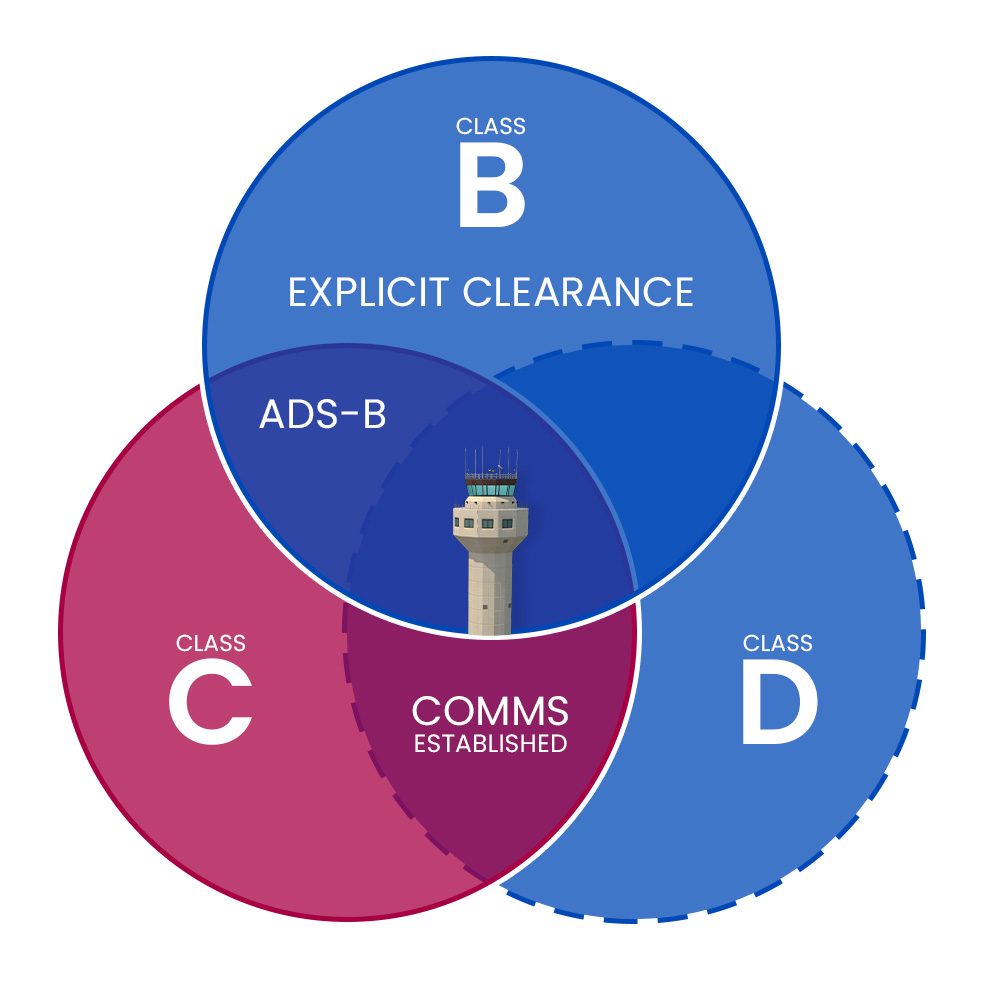 Class B airspace requirements: two-way radio communication (with approach controller), plus the aircraft must be equipped with a Mode-C transponder, and an operating ADS-B Out unit. Also, and this is important: ATC must include the phrase, “Cleared into the Class Bravo airspace,” in their transmission. That explicit clearance is mandatory. Just hearing your callsign is not good enough.
If you're on VFR Flight Following headed for a Class B volume while talking to the approach controller, remember: You aren't cleared to enter until you're cleared to enter.
At some point in your long aviation career, you may overhear a pilot being admonished by ATC for entering controlled airspace without establishing two-way radio communications first. It’s unfortunate but it does happen. Luckily, you read up on the Gold Seal blog and know just how easy it is to stay on the sunny side of ATC and controlled airspace.
Fly with confidence.
About the Author

Jamie Beckett came to aviation as a second career after taking a handful of flight lessons on a whim. He’s made general aviation his focus for more than 30 years serving as an instructor pilot, restoring WWII aircraft, writing for a variety of aviation publications, and flying just for the joy of it. Visit Jamie's channel at www.youtube.com/@MadPropsAero